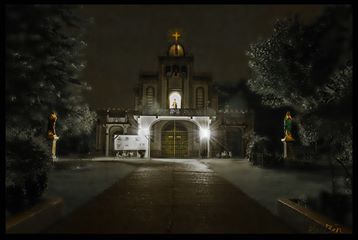
Villareal is a coastal town located in the southwestern part of Samar island. It is bounded in the north by Villareal Bay, in the east by Pinabacdao, in the west by Talalora and in the south by Sta. Rita.
History
In the late October 1596 the first Spanish missionaries to get to Samar arrived Tinagon, a place where Tarangnan is today, north across Maqueda Bay and only an hour's sailing distance from Umauas,- the place beside a river of the same name that developed into Villareal.
It has been suggested that the original site for settlement was either at Buaya or Sabang with bigger rivers and therefore easier to support a settlement of some size. The Spaniards later moved to the small Umauas River's side where it could be better defended against the Moro attack. The first early historical mention of the place referred to was Umauas, which means to flow. It perfectly describe the rapid rushing surge to the sea of the eponymous river whose mouth continues to flourish.
The legend of Umauas tells not of the flourishing but a famishing. It's a mix of animist and Christian elements, with Umauas somewhat like a Garden of Eden until a man and his wife transgress against the local gods, spirits of river and field and forest. Then does death by disease and hunger stalk, the land and the labor of man become as waster flowing down the river: UMAUAS.
It seems to be a folk memory of the famines and plagues that often visited Samar, sometimes lasting for years. From 1596 to 1597 for instance, at the start of the Christian conversions and as reported by the Jesuits, the mission turf Samar for nearly 200 years. By 1598 they had baptized over two thousand, many ill and dying. Umauas folk likely among them.
Umauas figures fairly in the Jesuit accounts, for it was at the Maqueda area that the missionaries worked first. They spread the Christian faith and the civilisation that went along with it. They gathered people in the villages which settled around churches built at first of wood, and later of stone, with fortification against Moro raids, schools, hospitals, whenever possible. By 1768 when the Jesuit left, expelled from all Spanish lands, the peculiar Philippine-Spanish Catholic culture had sunk roots and 18 towns had risen in Samar, one of them UMAUAS.
In 1768, Umauas, with a population of 650 families, was listed as pueblo (a pueblo consisted of poblacion, visitas, barrios, sitios) and also a parish. It shared a priest with Calbiga. In 1772, Umauas was subordinated to Calbiga. For a time in the next century, Umauas was a visita of Calbiga. If Umauas and Calbiga were in a kind of competition, Calbiga had the upper hand then.
However, it was soon after its municipal disgrace that Umauas had its most heroic year: 1773
In the last quarter of the 18'th Century, the Moro raids were at their height. In Samar the Franciscans had taken over from the Jesuits. With the Franciscan Fr. Vicente Lopez, Umauas had a parish priest and war captain.
In July 1773 Fr. Lopez, just ransomed from Moro captivity, returned to Umauas on the heels of another Moro raid, lost no time rebuilding the ruined church and convent and strengthening defenses: the watchtower, ramparts, cannons, fighting men. Late that year there was a minor encounter, then the Battle of St. Andrew's Day.
On November 30, priest and parishioners were at mass in church when the Moros attacked. Repulsed, the Moros went around burning crops and cutting down coconut trees to be used in their next assault. Fr. Lopez invoked St. Rose of Lima's aid and fired off a cannon, killing two chieftains of the Moros. They fell back, recovered, attacked again. The fighting lasted three hours. The Moros then withdraw and went off to besiege Paranas instead. Umauas was too tough for them.
Some time later Fr. Lopez and 45 men of Umauas set off in three boats at three in the morning for the nearby island lair of the Moro seadog Manguilala, sacked his fort and freed his captives. The spoils were divided between the priest and the raiding party and returned triumphant, thanks to God and our Patroness, Saint Rose of Lima.
Two successive victories, one occurring on the Feast of St. Andrew, a warlike saint and one of the legendary Seven Champions of Christendom, to whom the victory at arms would seem owed, but both attributed instead to reclusive Rose of Lima, a gardener's saint, whose patronage's nonetheless proved a true shield. Umauas never again falling in serious danger of Moro rapine although attempts on it continued to be made until as late as 1839.
As the alarms of war abated, the pursuits of peace prospered. A commercial report of 1860 listed abaca, coconut oil, and guinaras fabrics as Umauas's exports to Catbalogan and other pueblos of the province. But folk tradition speaks of a more extensive commerce; trade with Carigara in Leyte going back to earlier times; coconut oil carried in paraws directly to Manila later in the 19'th century; the county's largest trading firm needing a warehouse in the town at the height of the abaca boom soon after the turn of the century.
It was perhaps in recognition of the town's rising prosperity that as early as 1853 a decree restored Umauas to the status it lost back in 1772. Instantly rescinded though - it's said "for lack of priest" - but then affected ten years later.
March 12, 1863, is a significant date in the town's history. Not so much because it became once again an independent pueblo and parish. The truly significant change was the shedding of the ancient native name of Umauas and assumption of a regal Spanish title, VILLAREAL.
Presumptuous, perhaps, but it gave a name to the town's new self-image. If the townsfolk had anything to do at all with the choice of name, it means they had attained to the prosperous burgher's civic pride. The earlier rude town and the cruder citizens they had been - was what they wanted to bury. Now even the building of bigger houses and the sending of their sons away to good schools would serve a public purpose: to give their town something to boast of. But to begin with, a proud new name.
By 1890 Villareal had a population of 2,420 in the Polacion and 3,045 outside - more people than Calbiga. Eight visitas, no barrios though. But it also had a resident priest.
That the change in name reflected an actual change in the town's character is nowhere better seen than in its attitude toward priests. Back in the 18'th Century, few Samar pueblos gave their parrocos more trouble than Umauas did, the redoubtable Fr. Vicente Lopez notwithstanding. In one 1772 incident, a "citizen of the town" misbehaved at mass, afterward came at the priest with a drawn kris, and stopped only when the priest raised a musket at him. When the priest complained of such incidents, the town officials usually did nothing. Umauas for a time then, was under the influence of a heretical Samareno priest whose power the friars feared. But after the first Villahanon priest was ordained in the late 1800's, it seemed the youth of Villareal made a rush for the seminary. By the 1950's Villareal had produced more priests than any other town in Samar.
The spark of defiance can still fire up the younger Villahanon priests, but in obedience to God and conscience. Fr. Rudy Romano, virtuous by all report, for helping the poor and oppressed, was called a communist and probably killed: a martyr and Villareal's first likely candidate for sainthood.
Churchmen - Villahanon priests raised to the dignity of monsignor - were the first of its native sons to gain prominence beyond Villareal. A congressman, a governor, and other profane notables have risen from Villareal, but the world seem to know it only as town of priests, as if the world say only the men in holy orders.
The church has almost always been the first thing one saw of the town, coming by the immemorial sea way of early settler and Moro pirate and missionary priest. As the boat coming out of the Maquida Bay swings past the isle of Quindot into Villareal Bay, nothing so strikes the stranger on board, and so stirs the returning native as this sight: of church and convent behind castellated rampart up on a hill, with town below between hill and river, the Umauas: so like medieval scene of a castle and its attached village. Villareal indeed! The other thing that used to soon catch the eye was the big old house in Canlubay, which is that part of the town where the prow points to as the boat heads for shore; down where the shorefront curves eastward away from the river, there it stood, grand, one of several such houses in Villareal, now gone, like the rest but for one or two.
Some visitors from Calbayog City once stayed at the Canlubay house. They came away marveling at the great age of the house, the courtly manners and cultivated conversation of their host: things accustomed and ceremonious - proper to a town like their own city, the ecclesiastical capital of Samar, birthplace of its political kingpins, keeper of its culture kuno; unexpected in a backwater like Villareal. Somebody should have told them that when Calbayog was only a visita of Capul, back in the 18'th Century, Villareal under its old name was already a pueblo and parish.
The town of Villareal and Parish of St. Rose of Lima used to hold fiestas that drew a multitude of visitors who, days before the fiesta itself, came in the boats which the older folk remember seeing anchored so close together and so many they formed a pontoon reaching almost halfway across the harbor to Quindot. Of course they came for the patron, the misa de tres at the patron's shrine and the procession of her image. For the curioso, decana, pinato, rosquites, salvaro, local cookies, and the white cheese called just that, keseo. And the usual drinking and eating and dancing of the curacha. But first they came for the show: a drama in verse, song and dance the townsfolk traditionally put on for the occasion in serial parts over consecutive nights climaxing on the night of the fiesta. The stage was in back of the municipio, at the foot of the hill, the audience on the slope rising up to the church. For the duration of the play some of the visitors stayed with friends and relatives in town, others in their boats or in a makeshift sheds where, until the day of the festive tables, they cooked their own meals - yet even this was custom and ceremony.
Villareal, now more than two hundred years old, has become a big flourishing town with lots of enterprising professionals. From about six hundred families in 1768, its population has grown to more than twenty - three thousand people in 4,473 households according to the 2000 census. Many Villahanons have travelled to distant shores in quest of a better quality of life.But nostalgic memories of home -- like the celebration of the town fiesta in honor of their beloved St. Rose of Lima - always remain with them. Somehow, deep down in their hearts, a voice keeps saying: Be it ever so humble, there is no place like home.
The municipality of Villareal is estimated to be 65 kilometers southwest of Catbalogan, the provincial capital. It has a total land area of 239.4 square kilometers or 10, 432.9 hectares.
It is classified as a fourth class municipality belonging to the second political district of Samar with 38 barangays.
Barangays covered
1. Central 2. Mercado 3. Villarosa 4. Miramar 5. Tayud 6. Soledad 7. Banquil 8. Bino – ongan
9. Burabod 10. Cambaguio 11. Canmocat 12. Conant 13. Guintarcan 14. Himyangan
15. Igot 16. Inarumbacan 17. Inasudlan 18. Lam – awan 19. Lamingao 20. Lawa – an
21. Macopa 22. Mahayag 23. Malonoy 24. Nagcaduha 25. Pacao 26. Pacoyoy
27. Pangpang 28. Patag 29. Plaridel 30. Polangi 31. San Andres 32. San Fernando
33. San Rafael 34. San Roque 35. Sta. Rosa 36. Sto. Niño 37. Tomabe 38. Ulayan
Economic Activity
Agriculture is the basic economic activity, with rice, coconut, corn and banana as their primary products. An agriculture tenant earns as much as P1,000.00 to P2,000.00 per harvest time. Average yield per hectare is from 20 to 40 sacks of rice. Planting time is June, September and December.
Majority of the farmers own their farms. Average income of P5,000.00 to P10,000 is realized every harvest time. Traditional method of farming is still practiced by most farmers. Barangay Igot is the only barangay where Operation Land Transfer (OLT) program of the CARP has been implemented.
Other sources of livelihood are office employment, merchandising and cottage or home industries such as mat weaving and firewood production. Fishing is another source of livelihood, engaged in by most residents of the coastal barangays. Sources of their capital is privately owned.
Electric power
The electric power of Villareal comes from SAMELCO II or Samar Cooperative II. There are 22 barangays with electric power connections, while there are 16 barangays without power.
Employment
Farming and fishing are the most common livelihood activities engaged in by the both fathers and mothers in almost all barangays.
Government employment is another source of livelihood, with few people employed in most barangays. There are many people who are engaged in merchandising or buy – and – sell in the poblacion barangays. Some families are engaged in home industries or cottage industries aside from farming and fishing.